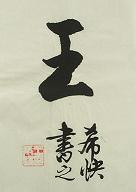
How to write Chinese Calligraphy - Essentials of writing technique

Writing technique in a broad sense includes the way to hold and use the brush to write characters. There are countless ways to wield the brush. I shall dwell only on the basic ways.

The Chinese term qi bi literally means to begin your stroke. The term shou bi means to end your stroke.

In writing characters each stroke involves qi bi and shou bi. If the stroke of a Chinese character is regarded as the basis of word construction, qi bi and shou bi are essential steps that determine the form of your stroke.

You must not make indecisive strokes -not knowing how you are going to write the strokes and where they are leading to. It will also not do if the strokes become unrecognizable-if the forceful strokes can't be told from the light strokes. If you are indecisive in writing strokes in calligraphy, your characters will be like withered trees, formless or styleless. The beginner will not be able to master the technique, but must pay due attention to the technique. Some people have been writing Chinese characters for several decades and still don't know the technique of qi bi and shou bi. They tend to neglect the technique. It is necessary to focus attention on it as you begin to write characters and cultivate good habits in writing strokes as you go along.

The basic approach to qi bi is: If you want to write a horizontal stroke, you must hold the brush per-pendicularly to begin with. To do a perpendicular stroke, begin it horizontally.

The basic approach to shou bi is: When you end your perpendicular stroke, you must make the stroke appear like dew about to drop. When you end your horizontal stroke, you must proceed to the right and then come back to the left. This process is repeated each time.

Lift and press the brush
When you write words on a piece of paper, you don't use the same force all the time. You first lift the brush up, then press it down. Writing involves an alternate process of lifting up and pressing down. Sometimes you do it with a heavy hand, sometimes lightly. The characters appear heavy or fine. You may do a stroke with a hook or do a downward stroke slanting towards the right. In this way the strokes give viewers a sense of rhythm.

The idea conveyed through the dot or the dash will come to life. The style of the calligraphy will appear on paper.

Zang feng and lu feng
What is feng? The tip of the brush has a central part of sharp, long hair (the main part), and its sur-rounding part of shorter hair. If you spread the hair evenly, you will see under sunlight that the tip of the main hair is transparent. This is called feng -the tip of the brush. It also means the cutting power of your brush. The term zang feng refers to first and last touch of the brush tip on the paper hidden in the writing stroke. In qi bi or shou bi you do not reveal these touches. This enables the cutting power of the brush to be kept in the strokes of the characters. The zang feng stroke imparts a suggestion of power, not revealing all that is in the mind of the calligrapher. This is what the ancient Chinese call sparing your cutting power in order to contain you energy or vitality.

Lu feng, in contrast, means a deliberate revelation of the cutting power of your brush, providing viewers with a sense of sharpness. This is what the ancient Chinese describe as revelation of the cutting power of the brush to give free rein to the spirit.

The zang feng method of wielding the brush means you turn the point in the direction opposite the one intended. For example, if you want to write a stroke from left to right, begin it by pressing the brush point to the right and then moving your brush a bit to the left to write the stroke to the right. End the stroke by returning a bit to the left. The cutting power of the brush will then be contained within the stroke.

Lu feng means the tip of the brush does not come from the opposite direction. You don't keep the cutting power of the brush within the stroke. The cutting power is revealed outwardly.

Zhuang feng and zhe feng
Zhuan feng is used to write a round dot. This calls for nonstop turning of the brush. Just let the tip of the brush go round and round. The dot will not become a square. Make a turn and it will be round, ancient Chinese said. This is what is meant by the term zhuan feng.

Zhe feng is used to write square strokes. The Chinese term zhe means to twist or bend. You break the line of your stroke to make a square, ancient Chinese said.

Zhong feng and ce feng
Zhongfeng, or the central cutting power of the brush refers to keeping your brush point always in the middle of the stroke. In this way the strokes will be full and round, will have a three dimensional effect and will not appear plain. Ancient Chinese tended to overstress zhong feng, but they had a point there.

Ce feng means the writer uses the brush point one-sidedly or in a sidelong manner. The brush point is on one side of the stroke. Ancient Chinese described zhongfeng as a means to exert vigor, while ce feng was a means to achieve elegance or beauty. A foremost calligrapher, Wang Xizhi (303-361), wrote his introduction to the Orchid Pavilion beautifully. The beauty of his calligraphy lies in his sidelong effect. Of course, he uses both zhong feng and ce feng as the necessity arises.

The ten writing skills mentioned above are not isolated. Related to each other, they form an integral movement. I have described them one by one only for the sake of convenience. Calligraphy is an art. The skills, too, form an art. As such they are the result of long practice. It is difficult to describe their details or delicate points in words. In writing be sure to pay attention to each one and use them flexibly.

Book References Guo, Bonan 1995. Gate to Chinese Calligraphy. Beijing: Foreign Languages Press.

Source : http://www.chinavoc.com/arts/calligraphy

How to write Chinese calligraphy - The way to hold the brush

To practice calligraphy, you must learn the proper way to hold the brush. This has much to do with the body's posture. You must hold the brush properly and also learn how to use your wrist and elbow while writing.

Body posture
Your posture while you write depends on the size of the characters you intend to write and your physical conditions. Proper posture will affect the speed of your progress and also your health. A contemporary calligrapher named Tang used the wrong posture, and though he became a calligrapher, he became a hunchback as well. He is called Tang the Hunchback.

What is the correct posture for writing? When sitting, the body should be erect, the shoulders balanced and the back straight. The legs should be apart, the feet evenly and firmly on the ground. The paper is held down by the left hand. The right hand holds the brush. The head is slightly forward, but be careful not to bow too low. Fix your eyes on the spot where you intend to write. Your eyes and the tip of your writing brush should be thirty centimeters apart. Your whole body should feel natural; do not pay undue attention to posture, or your body will become stiff or rigid. Correct posture simply prevents deformity of your body and enables you to write well. If you write characters larger than ten centimeters, you have to stand up and write. You may use any appropriate posture, depending on the situation.
Proper posture for writing while seated.
Proper posture for writing while standing.
Finger method
The important thing about holding the brush is the rational way of holding the five fingers and the coordinated use of these fingers. The functions of the five fingers are called ye, ya, gou, ge and di in Chinese.

Ye means to press down and refers to the use of the thumb. The thumb should press the brush slantwise from inside to outside. Ya refers to how the index finger holds the brush handle. Move the finger slantwise and bend it slightly from outside to inside. The index finger and the thumb coordinate, so that one presses and the other holds the brush handle.

Gou (hook) is the way the middle finger hooks the outside of the brush. Move this finger forcefully from left to right to hook the brush. The middle finger must coordinate well with the third finger to write characters. Ge refers to the way the third finger press the brush. The third finger is placed on the inside of the brush handle pressing the handle from the inside to the outside. It coordinates with the middle finger, so that the two fingers exert an even and balanced force.

Di refers to the work of the little finger, which is placed under the third finger to help it.

The important points in holding the brush are: The fingers must exert substan tial force. The palm does no actual work. Xu Chengyi, a calligrapher, recommends the following:
The tiger's mouth is like a crescent moon.
The palm is shaped like hiding an egg.
If the five fingers coordinate with each other,
The movement of the brush will be agile.
Holding the brush
Supported wrist method.
Method of using the wrist
Besides the fingers, one must use the wrist and elbow to write Chinese characters. The wrist is crucial and must be used with agility. You use the wrist to manipulate the tip of the brush. The four positions of the wrist are: rest, cushion, lift and suspend.

Rest the wrist of your right hand on the table. This will enable you to use your fingers well. Employ this method when you are writing very small characters-as small as the head of a fly, the Chinese say.

Cushion the wrist of your right hand. Usually you cushion it with your left thumb or your left wrist. This lifts your right wrist. This method is very often used for writing ordinary small characters.

Lift your right wrist from the table. Some people also call it suspending the wrist. It is used to write medium-sized characters.

The last position is to suspend both the wrist and the elbow. Neither touches the table. This method is used to write big characters.

These four wrist positions are only relative. If you intend to raise your calligraphy to the level of art, you must practice the suspended-wrist position from the very beginning. Would-be calligraphers must not be afraid of difficulty. They must acquire this basic skill.
Raised wrist method.
Suspended wrist method.

Book References
Guo, Bonan 1995. Gate to Chinese Calligraphy. Beijing: Foreign Languages Press.

Source : http://www.chinavoc.com/arts/calligraphy

Changes in writing style

There are different writing styles, or scripts written by hand in the Chinese language. The breakdown in style is roughly as follows: zhenshu (regular script prevalent in the Han Dynasty), caoshu (cursive script), lishu (official script) and zhuan-shu (seal character script). Chronologically, script style has experienced three epochs in the course of its over four thousand years bf history. The three epochs are marked by three different scripts that came into fashion: seal character script, official script and regular script. The seal character period ran from the end of primitive society to the Qin Dynasty (221-206B.C). The period, lasting more than two thousand years, is divided into three phases: early seal character, greater seal character and lesser seal character.

Early seal characters are characters written by primitive people, being the earliest form of writing on record. The inscription on the pottery vessel in Dinggong Village is an example of this. It has a mild style and assumes varied postures. The characters look like a length of knotted rope. This form of writing was perhaps related to the use of rope by primitive people to record events. However, this point needs investigation.

Greater seal characters generally refer to ancient scripts of pre-Qin Dynasty, such as inscriptions on bones, tortoise shells, bronze vessels and drum-shaped stone blocks and the ancient language of the Six States.

Inscriptions engraved on bones and tortoise shells belong to the ancient language of the Shang and Zhou dynasties. Seal characters' feature is that strokes are carved in the round; however, the seal characters in inscriptions on bones and tortoise shells are mostly stiff and straight, because it is not easy to make a turn with the cutting edge of the tool in engraving. If we compare inscriptions on bronze vessels or hand script with inscriptions on bones and tortoise shells of the same period, we shall find that inscriptions en bones and tortoise shells have the attributes of the greater seal character script.

Early inscriptions on bronze vessels were first engraved on a clay mold and later cast on the bronze. Since it was easy to engrave on clay, the brush strokes showed roundness, fullness and roundabout turns. These features have been preserved to this day in vivid forms. Inscriptions on bronze vessels of later periods were engraved directly on the bronze with sharp knives or chisels. The characters became decorative, known as suspended-stitch seal characters.

Inscriptions on drum-shaped stone blocks were discovered in the early Tang Dynasty (around the year 618) in Shaanxi Province. The inscriptions were written in language of the pre-Qin period. They are famous works of calligraphy belonging to the period preceeding the Qin Dynasty and are in the collection of the Palace Museum in Beijing. Scripts of the pre-Qin period also include the ancient language of the Six States. They are all classified as greater seal character scripts.

Lesser seal character script was the officially approved script following the unification of Chinese languages by the Qin Dynasty. It is also known as Qin seal character script. Since it contrasts with the previous seal character script, the two are called greater and lesser. The Qin Dynasty used lesser seal character script to engrave inscriptions on stones extolling the merits of persons or things, to engrave seals or marks of authenticity or emblems or to write imperial edicts. It replaced greater seal character script, marking tremendous historical progress. For a country the size of China, where dialects are more numerous than in the various countries of Europe, a unified written language plays an important part as a link between various nationalities to cement national solidarity and achieve national unification. It was the Qin, or lesser, seal character script that served as a link and deserves much credit.

An outstanding work representative of Qin seal calligraphy is the writing of Li Si (?-c 208 B.C.), regarded as the father of lesser seal character script. He exerted a profound influence on the seal character script of later generations.

Kaishu - formal/regular style

Kaishu came into use in China at the end of the Han Dynasty. It is still used in China today after more than 1.700 years. It is the main Chinese writing style, called kaishu, or regular script. It is also called zhengshu or zhenshu.

Kaishu was initiated by Wang Cizhong toward the end of the Han Dynasty, according to legend. In the Wei-Jin period Zhong You (151-230) and Wang Xizhi(303-363) initiated a new way of writing that allowed kaishu and lishu to separate and form two systems. Chinese script unused today in China to serve the needs of society are kaishu (regular script) and xingshu (running script), but in the art arena zhen, cao, official script and seal character script compete with each other. They give a resplendent view of the beauty of calligraphy and the depth and breadth of this Oriental art, formed through several thousand years of ancient culture.

To study Chinese calligraphy, one should begin with kaishu. The next step is to study carefully various other scripts and absorb their good points. In this way one will create a unique style of one's own.

Lishu - Official (/Clerical) Style

This form of Chinese script germinated in pre-Qin times. By the Qin Dynasty it came to be used by low-ranking officials in the Chinese government. It simplified the more complicated strokes of seal character script and used a bend instead of making a roundabout turn. Lishu is attributed to Cheng Miao, who lived in the state of Qin. The script was used by clerks working in prisons, hence the Chinese term lishu (servitude script). By the Han Dynasty it was promoted as a writing style. In over four hundred years of propagation lishu created many schools of writing. Lishu was underwent a development of over four hundred years through the Wei, Jin, Southern and Northern dynasties. By the latter part of the Southern and Northern Dynasties the script rid itself of any remaining influence of lishu, attaining complete maturity.

Chinese calligraphy entered its golden age during the Sui and Tang dynasties, when China produced the largest number of calligraphers and made the greatest achievements in calligraphic art, unmatched other historic periods or dynasties. I mentioned four schools of calligraphy before: Yan, Liu, Ou and Zhao. Of the four the first three thrived in the Tang Dynasty.

The above is a rough account of the history of Chinese calligraphy. The scripting, lishu branched out into xingshu(running script) and caoshu (cursive script), written in a flowing style with the strokes joined together. Lishu may be said to be the harbinger of running and cursive scripts.

Book References Guo, Bonan 1995. Gate to Chinese Calligraphy. Beijing: Foreign Languages Press.

Source : http://www.chinavoc.com/arts/calligraphy

Calligraphy Set - Four treasures of the study

What Chinese calligraphy supply do you need? To write Chinese characters, you need a brush, ink, paper and ink stone, commonly referred to as the four treasures of the study. In order to learn calligraphy, it is necessary to learn about these tools, select them carefully and take care of them. As the saying goes, one must temper the means to achieve the end. This is by virtue of necessity.


  • Brush
  • Ink Stick
  • Paper
  • Ink Slab or Ink Stone


Brush

The brush was invented by Meng Dian (?-210 B.C.), according to legend, yet primitivepainted pottery had decorative designs painted by tools more or less like a brush. Clearly visible stains or marks of a brush were left in certain places on the pottery. From this it may be surmised that the brush predated the written language itself. The history of the Chinese brush can be traced back at least six thousand years.

That Chinese calligraphy has become an art that enjoys a worldwide reputation is in a large measure related to the use of the brush to write the characters. The head of the brush is made of the hair of the goat, wolf, rat or rabbit, which is softer than bamboo, pencil, quill or ball pen. Because of its softness its written strokes can be light or heavy, thick or fine. The strokes flow naturally, entering an artistic world with an element of wonder. Other materials may give you a handsome style, but they can hardly attain the level of achievement in calligraphic art executed by the brush.

Writing brushes are soft, stiff or a combination of the two. A soft writing brush is flexible and easily moistened with ink. Made of aoat hair, it is called yang hao in Chinese. Some calligraphers think beginners should use this brush to practice handwriting, since it facilitates forceful writing. Practice begins with medium-sized characters, however, which call for regularity and neat lettering. Thus it is advisable to use a combination writing brush, since it is difficult for the beginner to handle a goat-hair brush.

Stiff Brush
This brush is stiff and hard and does not hold a large amount of ink. Made of wolf hair,itiscommonly called a wolf-hair brush. To practice writing small characters, which call for regularity and neatness, it is better to use a stiff brush.

Jian hao, or a combination of stiff and soft hair, contains goat hair and the hair of another animal. Rabbit hair is somewhat purple, so a rabbit-hair brush is called a purple brush. The ratio of hair may be 70 percent rabbit hair and 30 percent goat hair or vice versa or 50 percent of each. Zi yang jian is the name in Chinese for a rabbit-goat writing brush.

Selecting the writing brush

The Chinese brush may be big or small, stiff or soft. The important thing is that it serve your own practical purpose. Generally, a big, soft brush is used to write large characters and a small, stiff one to write small characters. The point must be "round like an awl" that can be "pressed like a chisel". The Chinese brush point should have the following characteristics: roundness, pointedness, evenness and strength. Roundness means the point should be rounded and robust. Pointed-ness means it should be as sharp or pointed as an awl. Evenness means that when you spread the brush and hold it down, the brush is even. Strength means the point is flexible or elastic. You can moisten a new brush in your mouth, then press it forward and backward on your thumb. The brush will go round and round smoothly. When you pick the brush up, it will return to its former shape naturally becoming as sharp and pointed as before. This means your brush is all right.

Protecting your brush ink stick
A new brush has a sticky coating that must be removed by immersing the brush in warm water (do not use hot water). The hair will then fluff out. Do not try to remove the glue by force. Do not use your teeth to remove the glue. The glue on brushes for writing small characters should be removed from two fifths of the length of the hair. The glue on brushes for writing medium-sized characters should be removed from half the length of the hair, and the glue on brushes for writing big characters should be removed from two thirds the length of the hair. It is not advisable to remove all the glue from the brush. If it is removed entirely, the brush will not have the required force or rigor. How much glue should be removed just depends on the convenience of the user.

The brush for writing big characters must be washed in clean water after use. Be sure no ink is left on the brush, which should be carefully groomed. The brush should be hung up with the tip downward. The brush for writing small characters must be put in a sheath after use, to protect it from gluing up. If the brush is not used for a long time, it must be kept in a box or a bag. Camphor balls should be used to protect the brush from being moth-eaten.

Ink Stick

Legend says that King Yi first invented ink stick about 2,800 years ago, yet archaeologists have detected ink marks on the back of inscribed bones or tortoise shells of the Shang Dynasty, 3,200 years ago. There are many varieties of ink stick. The most famous is hui mo;(Anhui ink stick), made from the pines that grow on Huangshan (Yellow Mountain) in Anhui Province. The trees are burned and the soot left after burning makes excellent ink stick. Xi, a famous ink maker, moved to Shexian County in Anhui at the end of the Tang Dynasty (618-907). His method for making ink stick from pine soot was handed down to later generations. Such a ink stick has enjoyed a good reputation for more than a thousand years. The Anhui ink stick has magic qualities. It is as hard as stone and does not deteriorate for as long as ten years. The ink produced from the Anhui ink stick is as black as black paint. Many charming stories and anecdotes about the Anhui ink stick have been recounted in literary circles, past and present. Ink sticks fall into three major categories, according to the chief materials used in manufacture. The pine-soot ink stick. This is made with the mixture of pine soot, which is the main part, a certain amount of glue, medicinal material and spices. The oil-soot ink stick. Tung oil, sesame oil, rapeseed oil or petroleum is burned and the soot is mixed with gelatine, medicinal material and spices. The oil- and pine-soot ink stick. This is a mixture of the previous materials for making the oil-soot ink stick and pine-soot ink stick. Proportions vary, and the quality of the ink stick differs accordingly.

Choosing the ink stick
The quality of the ink stick may be judged by its color and sound. Glossy purple is best. Black is second. Glossy green is third. Glossy white is last. If you strike the ink stick and it gives a light sound, this means it is a fine ink stick. If the sound is muffled, it is not a good one. If the sound is fine when you grind the ink stick on the slab, it means you have a good ink stick. If the sound is rough during grinding, it means the ink stick is none too good.

How to grind the ink stick
Clean water is used for grinding. The best water contains a small amount of salt. Next comes well water, then tap water, then distilled water. Do not Use tea or hot water to grind an ink stick.

The ink stick must be balanced in the hand during grinding or rubbing. Press hard and rub lightly. Rub the ink stick slowly and evenly against the ink slab or ink stone in big circles. At first use only a little water. When a thick liquid forms, add water and rub or grind again. The thickness or thinness of the ink depends on how much or how little you need to use. If the ink is too thick, it will be difficult to use the tip of the brush, which will glue up. If the ink is too thin, it will probably filter through the paper.

You may use prepared liquid Chinese ink to write Chinese characters during ordinary practice sessions. This form of ink is very convenient. If the ink is too thick, pour out a small amount from the ink bottle, add water and rub. Don't pour water into the bottle of prepared liquid ink. You will only spoil the glue, which will stink. In learning calligraphy it is best that you rub or grind the ink stick on the ink slad or ink stone. If you use prepared liquid ink you will not enter the art world. Rubbing or grinding the ink stick against the ink slab or ink stone prepares you for practicing handwriting. During the rubbing or grinding you have time to study the specimen of writing that you intend to copy. This will enable you to make better progress in the course of time. So whenever you can, rub or grind the ink stick against the ink stone yourself.

Paper

Paper was invented by Cai Lun (7-121), according to legend. Archaeological discoveries reveal, however, that in the early Western Han Dynasty, or two hundred years earlier than the time of Cai Lun, a coarse paper made of hemp had already come into existence. Paper is of many kinds, but Xuan paper has been considered best throughout the ages for Chinese calligraphy. Xuan paper is produced in Jing County, Anhui Province. The county was under the jurisdiction of Xuanzhou Prefecture in the Tang Dynasty. Jing County paper was first shipped to Xuanzhou, then transshipped to other ports. That is whv Jing County paper is called'Xuan paper. The paper is soft and fine textured, suitable for conveying the artistic expression of both Chinese calligraphy and painting.

Xuan paper has good tensile strength and not easily eaten by moths. It can be preserved for a long time. It therefore has the reputation of lasting a thousand years. There are numerous kinds of Xuan paper, such as dan, jia, luowen, coral, tiger-skin and jade-plate. Quality depends on whether the paper is unprocessed, processed or half-processed. Unprocessed paper absorbs water easily. Ink filters through this paper easily, too. Put your brush on this paper to make sure the thickness or thinness of your liquid ink is suitable. Processed paper goes through a process whereby gelatine made from bones and alum are added. This kind of paper does not absorb water easily. It is stiff or hard to the touch. Half-processed paper has a neutral character, in that it absorbs water, but it does not filter through easily.

Xuan paper for painting and calligraphy is rather expensive. Beginners can use coarser, rougher paper instead. More commonly used paper includes yuanshu, maobian and baima. It is not good to use too glossy a paper, such as youguang and kaobei. It is easy to practice forceful writing on coarse, rough paper, but not on glossy, smooth paper. Calligraphers in ancient China used to practice writing on stone slabs found by the side of >a well, because it was difficult to obtain paper then. In the end they became good calligraphers. In modern times white-painted wooden boards, thin plastic film and plastic sheets are used as substitutes for paper to practice writing. You may erase the characters with a wet cloth and write again. You don't need to use paper, and the result is just as good. It's somewhat to your advantage to use coarse paper. If you practice handwriting under less favorable conditions, you develop greater adaptability. Do not think that you cannot produce good handwriting if you do not have good-quality paper to practice on.

Ink Slab or Ink Stone


When the ink slab was invented is a rather controversial question. Ancient Chinese attributed the invention to the Yellow Emperor, yet the ink slab had been in use in primitive times, six to seven thousand years ago, two thousand years earlier than the era of the Yellow Emperor, to produce colors. Archaeologists have discovered many ancient ink slabs, such as a jade ink slab of the Shang and Zhou dynasties, a stone slab of the pre-Qin Dynasty, a painted slab and a painted slab mixed with sand belonging to the Han Dynasty, copper and silver slabs as well as iron slabs of the Wei and Jin dynasties, a blue porcelain slab of the Six Dynasties and a clay slab of the Tang Dynasty. Most ink slabs, modern or ancient, were made of stone. The earliest ink slab was made of stone and acquired the greatest popularity. Ink stones or ink slabs have been classified into three categories since the Tang Dynasty: Duan, She and Tao.

Duan ink slab

Produced in Zhaoqing, Guangdong Province, it is made of Duan stone, so named because the Duanxi River runs at the foot of Mount Fuke, where the stone is found. Said to be the best stone for making ink slabs, Duan stone was used to make ink slabs as early as the Tang Dynasty (618-907). Duan ink slabs have earned a high reputation among Chinese scholars ever since.

She ink slab

It is named after Shezhou Prefecture, Anhui Province, where it was first produced in the Tang Dynasty. Many counties under the jurisdiction of this prefecture produce She ink slabs, but the best come from Mount Longwei, Wuyuan County, Jiangxi Province. Sometimes She ink slabs are referred to as Longwei ink slabs.

Tao ink slab

This ink slab has been produced in Taozhou since ancient times. Now it is produced mainly in Taoyan Village, Zhuoni County, Gansu Province. Tao ink slabs are made of stone found at the Tao River; hence the name.

One feature common to all three kinds of ink slabs is that the stone is hard and fine. Though hard, the stone is not dry. Though fine, it is not slippery. With a hard, smooth stone you produce liquid ink easily by rubbing the ink stick against the stone. Since the stone is fine, but not slippery, it yields ink very quickly.

Any stone not too glossy or slippery or too coarse or rough may be used by the beginner. The slab may have a cover, since a covered slab stores ink more easily. The ink will not blow away or dry up.

In grinding the ink stick against the ink slab exert your force evenly, so as to keep the ink slab steady. Grind only the ink you need for writing. After use, the slab must be washed clean. Leave a bit of clean water in the center of the slab. This will keep the slab in good condition. Take care not to stain the slab with oil or grease.

Book References Guo, Bonan 1995. Gate to Chinese Calligraphy. Beijing: Foreign Languages Press.

Source : http://www.chinavoc.com/arts/calligraphy

Analysis of Chinese characters ( Calligraphy alphebet)

Calligraphy is the art of writing Chinese characters. To understand calligraphy, one must first know something about Chinese characters. The various nationalities in the world have created their own languages, but the Chinese have created an independent calligraphic art. Why? The reason is mainly related to the features of the language.

Languages fall into two systems; one expresses sound; the other expresses meaning. The cuneiform writing of the Sumerian, the Katakana in the Japanese language, English, French, Russian, German and Latin-these languages are phonetic. The language of the sacred books of ancient Egypt, the pictographic language of Crete, the Chinese language and the language of the Dongba nationality are all ideographic.

Ideographic languages have for the most part become extinct. Only one such language, Chinese, is still widely used today. A comparison of the two systems of language indicates that a phonetic language has an advantage over an ideographic language. Alphabets with few letters can easily be learned and memorized. Such a language can be popularized more easily. The pinyin form of Chinese represents the direction of language development. An ideographic language has a great many symbols. The morphology is cumbersome and difficult. It is hard to learn and remember it. Such a language cannot easily be popularized.

The inscriptions on bones and tortoise .shells of the Shang Dynasty, three thousand years ago or so, had vocabularies of five thousand symbols. The recently published Han Yu Da Zi Dian, a comprehensive Chinese-language dictionary, has over 54,000 entries. So vast is the Chinese vocabulary! Every character can be written in regular script, grass script, official script, etc., and every script can be written differently, ranging from a few to as many as scores of styles. The largest runs to about one hundred. For example, bai shou tu shows one hundred ways to write shou (longevity) in official script.

The Chinese language contains an enormous number of characters. A Chinese who spends his entire life learning to write his language will find it difficult to complete his task. The difficulty facing the novice can hardly be imagined.

Everything in the world is said to have a dual character. If it possesses advantages, it will also have drawbacks. This is also true to language. In the case of Chinese there is a huge stock of characters and the morphology varies greatly. This means that you can write words in many ways. The drawback is thus turned into an advantage. It opened up a huge vista for Chinese calligraphy to develop into an independent art. Chinese characters may be difficult to master, but they are governed by rules. Just like notes in music, characters are formed by changing the combination of elements. Tens of thousands of words in Chinese can be broken down into several hundred component parts. Take, for instance, the two characters Zhong Guo (China). The character zhong is made up of and a vertical stroke . The character guo is made up of and . Further analysis of Chinese characters leads to the discovery that there are eight basic strokes: namely, dot ( ), dash (), perpendicular downstroke ( ), downstroke to the left ( ), wavelike stroke ( ), hook ( ), upstroke to the right ( ) and bend ( ). The eight basic strokes, like notes in music, can be developed into many "tunes" and "movements", or schools of Chinese calligraphy.

Every Chinese character can be said to contain a picture. The two characters and show sunrise and sunset. In primitive pottery inscriptions was written as , made up of (sun), (moon), and (mountain), showing that the moon had gone down behind a mountain and that the sun is rising. The character was written as in ancient script. In official script it is written as . indicates grass. indicates a thick growth of grass. The picture shows that the sun has set behind a thick growth of grass. It is not too much to say that these two characters are pictures of sunrise and sunset. The reason why Chinese calligraphy has devel oped into an art containing images may be closely related to the fact that a picture stands for a word. Some will perhaps remark that Chinese calligraphy is the art of the brush. This is true. If you use a stiff or hard pen, it is difficult to write such beautiful characters as done by the brush. If you try to use a brush to write the twenty-six letters in the pinyt'n system, it is also difficult to create such beautiful images as in Chinese calligraphy.

Book References Guo, Bonan 1995. Gate to Chinese Calligraphy. Beijing: Foreign Languages Press.

Source : http://www.chinavoc.com/arts/calligraphy

Origin of calligraphy - ancient Chinese Calligraphy history

When did calligraphy originate? This question probably interests everyone who wishes to study calligraphy. No precise date is given in ancient Chinese history. Legend says that during the reign of the Yellow Emperor a man named Cang Jie invented the Chinese language. Calligraphy came after invention of the language. We may attribute- the invention to 4,600 years ago, but this is only a legendary tale and may not be credible. What is interesting, however, is that archaeological discoveries since the birth of new China have authenticated that 4,500 years ago language came into existence in China. It follows that calligraphy entered an embryonic stage then.

Left photo is an ancient sunrise painting. The painting was a design inscribed on a big-mouthed pottery jar-a sacrificial vessel to the sun by primitive Chinese forebears in Shandong during the period when the Dawenkou culture thrived (4000-2000 BC).

This painting, or design, consists of three parts: upper, middle and bottom. The upper part is a round sun. Below it is a moon. A huge mountain with five peaks is at the bottom. Some experts think this might be the original of (dan4) "sunrise", with the sun above a cloud (or perhaps above the setting moon), on top of a mountain. The same character appears in inscriptions on bone or tortoise shell, on ancient bronze vessels, in lesser seal characters, in official script and in regular script in later times. The origin of the character is the picture. From the angle of calligraphy we might regard the sun in the picture as round as a circle. The moon is a bit wavelike. The mountain is drawn with the brush exerting strength. The shapes of the moon and the mountain are well proportioned on left and right, imparting a sense of balance. The arrangement is small on top and big on the bottom. The top is round, the bottom flat. This gives one a sense of steadiness. As calligraphy, the character is well written insofar as technique, structure and presentation are concerned. The character has a strong rhythmic sense.

Let us look at another calligraphic work by primitive Chinese forebears-an inscription on pottery discovered in the ruins of the ancient Longshan culture in Dinggong Village, Zouping County, Shan-dong Province, in January 1992. There are five lines with eleven characters on the pottery piece. The lines seem to flow. The arrangement is good and well composed. The design on the Dawenkou culture pottery jar is a mixture of painting and calligraphy, difficult to distinguish, but the language on the Longshan culture pottery piece may be described as mature. To date, it is the most ancient calligraphic work in China. It may well be described as the embryo of calligraphy in seal characters. It is 4,300 years old.

Chinese calligraphy is at least four thousand years old, based on legendary tales and on textual criticism in archaeology.

The two primitive calligraphic works are both inscribed on pottery pieces by sharp tools. Therefore in the opinion of calligraphic historians they are the earliest works written by means of sharp tools-a sort of metal brush, or "hard" brush as the Chinese say.

Surviving writings made with a metal tool are much older than surviving writings made with a brush, but of course this is because the harder, incised materials have lasted, while any brush writings on materials such as bamboo books, wooden slats, silk, animal skins, etc. have long since disintegrated. The inscriptions on bone or tortoise shell of the Shang Dynasty are outstanding examples of metal-tool calligraphy.


True enough, these inscriptions are outstanding examples of ancient Chinese calligraphy written by means of a metal tool, but it would not be correct to say that all inscriptions on bone or tortoise shell were done by means of a metal tool. Be ore being inscribed with a metal tool, some were first drawn by a brush. They were inscribed on bone or shell later. The style of the calligraphy on the pottery piece in Dinggong Village is too complicated to have been inscribed directly on the pottery with a sharp tool. It is possible that something like a brush was used to write the calligraphy. In other words, calligraphy written by means of the brush also has a history of over four thousand years in China.


Book References Guo, Bonan 1995. Gate to Chinese Calligraphy. Beijing: Foreign Languages Press.

Source : http://www.chinavoc.com/arts/calligraphy

What is Chinese Calligraphy ?

Chinese calligraphy is an Oriental art. But what makes it an art?
It is very much like painting. It uses Chinese characters to communicate the spiritual world of the artist. Just as one thousand persons will have as many faces, one thousand persons will have as many differences in handwriting. Through the medium of form, way of handling the brush, presentation, and style, calligraphy as a work of art conveys the moral integrity, character, emotions, esthetic feelings and culture of the artist to readers affecting them by the power of appeal and the joy of beauty.

Calligraphy is not only a practical technique for writing Chinese characters, but also a unique Oriental art of expression and a branch of learning or discipline as well. As a branch of learning it is rich in content, including the evolution of writing styles, development and rules of technique, history of calligraphy, calligraphers and their inheritance in art, and evaluation of calligraphy as a work of art. This branch of learning is wide ranging and deep, forming an important part of Chinese culture.

Like chopsticks, this calligraphy used to be wholly Chinese. As Chinese culture spread to Korea, Japan, Vietnam and Singapore, calligraphy became a unique feature of Oriental art.

A Japanese friend once remarked with pride that Oriental culture has one more art than Western culture, by which he meant that language in the East is not mere symbol, but a lofty art-Oriental calligraphy.

Recently knowledgeable friends in the West have discovered the unique beauty of Chinese calligraphy. They say every character is written like a beautiful flower. Western scholars visiting China develop a keen interest in and love for Chinese calligraphy. They study Chinese characters, and from the construction of the characters .they seek to understand calligraphy. From calligraphy they seek to learn about Oriental culture. There are artists in the West who understand the abstract beauty of Chinese calligraphic art. They believe that Chinese calligraphy is the most ancient and most condensed of abstract arts. They praise this form of Chinese art as having the beauty of image in painting, the beauty of dynamism in dance and the beauty of rhythm in music. Thus abstract art-the ultramodern art of the West-takes cognizance of the most ancient art-calligraphy-of the East, establishing an intimate relationship between the two. Although calligraphy's home is China, it does not belong exclusively to China. It does not belong exclusively to the East, either. It's no exaggeration to say that calligraphy is a gem in the world's art treasury.

With a history of four to five thousand years, the art of calligraphy is rich and profound in content and has attracted the attention of artists the world over. The author of this booklet finds it difficult to treat the subject adequately or well in the limited space available, so he will confine himself to a brief discussion of the method and rules of regular script in Chinese calligraphy.

Book References Guo, Bonan 1995. Gate to Chinese Calligraphy. Beijing: Foreign Languages Press